

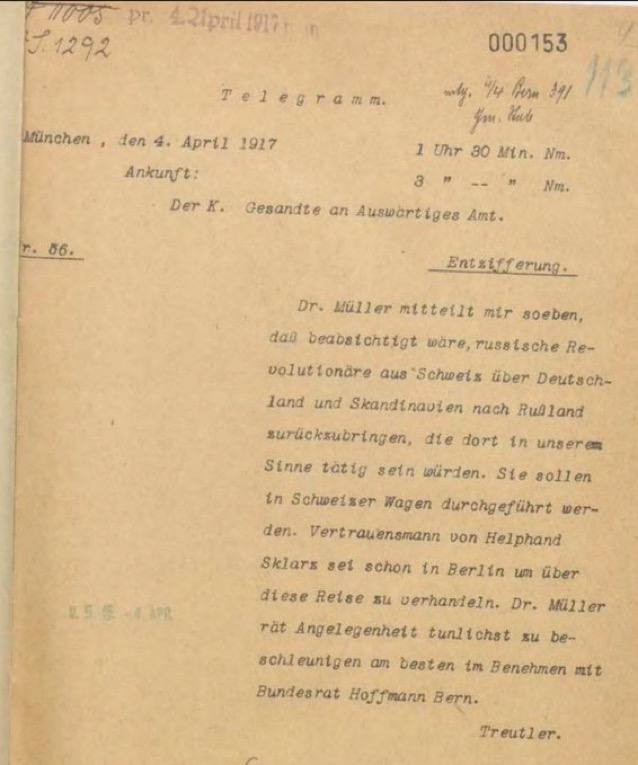
A telegram about Lenin and his associates, April 1917. From Wilhelm II's inner circle: they will be transported through Germany to operate "in our interests."
Lenin's compromising material, written down by the people who controlled his passage.
And look at who wrote it. Karl Georg von Treutler was not some random German diplomat. He came from Wilhelm II's close circle and had served as the Kaiser's confidant and adviser. He had accompanied Wilhelm on numerous journeys and represented the Foreign Office at the Kaiser's Supreme Headquarters during the war.
On April 4, 1917, Treutler reported that Russian revolutionaries were to be transported from Switzerland through Germany and Scandinavia into Russia, where, in his own words, they would operate "in our interests."
Then comes another remarkable detail: Parvus's own confidant, Georg Sklarz, was already in Berlin negotiating their journey.
So in a single primary-source document we have a man from Wilhelm II's inner circle, Parvus's trusted associate negotiating in Berlin, the organized transportation of Russian revolutionaries through wartime Germany, and an explicit statement of what Germany expected from them once they reached Russia:
"They would operate there in our interests."
That is one hell of a document.
t.me/RussianBaZa
A telegram about Lenin and his associates, April 1917.

🇷🇺☦️ Russian БaZa ☦️🇷🇺
@RussianBaZaPattern Recognition/ PsyOps Exposing Division reporting factual news, all things Russian, World events, and the SMO in Ukraine. For legal reasons this Channel is just humor and parody.🩸Кровь, Честь, Справедливость.
20,224 מנויים
פתח בטלגרם