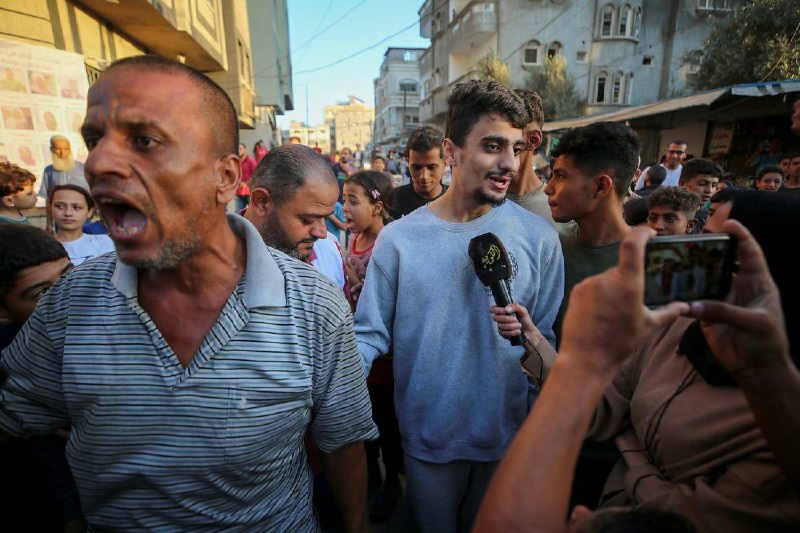
The most revealing sentence spoken from Gaza’s press corps this year came on a podcast from one of its greatest stars. “If someone says something like this, many journalists lower the camera.”
That is Motaz Azaiza—one of TIME’s 100 most influential people of 2024, GQ Middle East’s man of the year—explaining how, when faced with dissent, the Gaza media complex fixes the narrative on Hamas’s behalf.
Speaking on the Palestinian podcast Taqarob, Azaiza described a WhatsApp group that “all the Gaza journalists are in.” For anyone picturing a professional association: its icon is a Hamas flag, and its administrator, he said, is the media director of the Rafah crossing.
Azaiza is no friend of Israel. TIME’s honoree celebrated October 7 and filmed hostages being beaten in a Gaza street, but then promptly buried the footage. When Yahya Sinwar was killed, he told mourners that anyone who had not answered Sinwar’s call to go out and engage the enemy had “no right to mourn and boast about the manner of his death.” Sinwar, he wrote, “wanted you in the field.”
That Gaza is an authoritarian hellscape is hardly worth stopping the presses for. Anyone thinking critically assumed Hamas controlled the narrative from the very beginning. Azaiza’s testimony is less an indictment of Hamas than of the media complex that lapped up its releases.
The Committee to Protect Journalists ran a feature in May of last year in which the head of the Palestinian Journalists’ Syndicate listed Hamas’s methods—summonses, interrogations, threats, beatings, arrests, publication bans, interference with content, surveillance—and his deputy conceded that most journalists in Gaza now censor themselves. One photographer, beaten unconscious by plainclothes police beside Nasser Hospital, told CPJ that when colleagues tried to intervene, they were informed that “the spy and the journalist are one and the same.” CPJ noted the violations were vastly underreported, because the victims were too frightened to say so.
Despite publishing all that, CPJ joined the foreign press in doing what Gazan journalists did out of loyalty or under duress: carrying the Hamas line. For two years its casualty database was the load-bearing source for the charge that Israel systematically targets journalists. In June it quietly removed 20 names from that database—eight of them after Hamas and Islamic Jihad published obituaries claiming the dead as their own fighters. The Meir Amit Center found a further 23 examples, and there are doubtless more.
To be fair, “Totalitarian Islamists co-opt the press” is a far more compromising headline for a media organization to run than “Israel targets press.”
The foreign press has omitted Hamas control since 2008, when Hamas stopped the West Bank dailies at the crossing and told their editors, according to the head of the Palestinian Journalists’ Syndicate, that they could enter Gaza once they signed an undertaking not to criticize Hamas. It broke cover once again in 2014, when, in a rare moment of lucidity, the Foreign Press Association condemned the “blatant, incessant, forceful and unorthodox methods” used against its members in Gaza. A Hamas information official then confirmed it on Lebanese television: the security services, she explained, “would give them some time to change their message.”
When the war began, Hamas already had years of evidence that the foreign press would take what it was served. That is how a single group chat, with no foreign members, set a global narrative.
Will the world take note of Azaiza’s testimony? Unlikely. The most serious piece of journalism of Azaiza’s career will likely be his least cited.
(Amit Segal)
The most revealing sentence spoken from Gaza’s press corps this year came on a podcast from one of i

Amir Tsarfati
@beholdisraelchannelBeliever | Husband | Father | Bible Teacher | Four-time New York Times Bestselling Author | Conference Speaker | Middle East News Commentator | Founder and President of Behold Israel beholdisrael.org instagram.com/amir.tsarfati youtube.com/@beholdisrael
572,674 מנויים
פתח בטלגרם