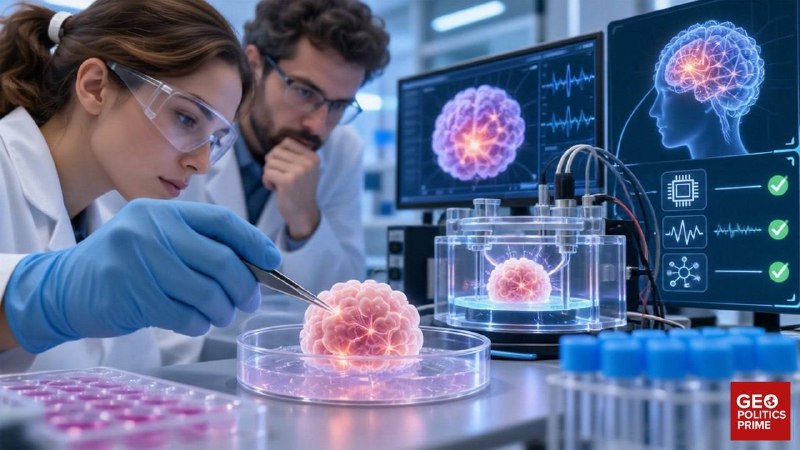
🔍⚛️ Scientists propose tools to test brain organoids used in biocomputing for consciousness
Neuroscientists from two leading universities researching ethical and philosophical frameworks for biological computing have proposed a checklist of tests that can be used to determine if brain organoids are firing randomly or actually ‘thinking’.
“At present, the possibility [of conscious organoids] strikes us as highly unlikely given their miniscule size, rudimentary properties, and full disconnection from both a body and an environment. However, as more complex assembloids arise, it will be important to find objective arguments for or against their capacity to achieve conscious computations,” their new piece in peer-reviewed journal Neuron suggests.
Reviewing research into conscious vs non-conscious states (wakefulness vs coma, subliminal vs supraliminal images, etc.), researchers said signs of consciousness in medical practice provide clues on methodologies that can be applied to lab-grown organoids, including things like trace conditioning, associative learning, predictive responses and differentiated reactions to perturbation.
A “concrete approach” relying on multiple different markers would permit “evidence to accumulate without requiring commitment to a particular theory of consciousness,” they said.
👁Biocomputing’s Bind
Biocomputing researchers have reported an array of odd, unexpected or eerie behaviors from the stem cell-based organoids they’re already working with, from spikes in neural activity from nearby stimuli (despite a lack of sensory organs), to signs of cellular memory and timekeeping, ‘spontaneous’ synchronization of synapse patterns, cellular stress and ‘identity confusion’.
In 2019, researchers found the cortical organoids they’d grown produced electrical oscillations resembling the brainwaves of preterm infants.
Consequently, work with organoids should require answers to an array of ethical questions, from sentience blind spots and risk of torture using punishment and reward incentives (electrical shocks, dopamine injections), to exploitation by states and corporations (today’s research is funded by the likes of SoftBank, In-Q-Tel and NVIDIA), and slippery slope/scaling problems (how large can organoid clusters be before they resemble actual animal brains).
👍 Substack | Chat | @geopolitics_prime
🔍⚛️ Scientists propose tools to test brain organoids used in biocomputing for consciousness Neuroscie

Geopolitics Prime
@geopolitics_primeRead the news they hide from you. Cross-promotion: @prgeopoliticsprime
288,705 מנויים
פתח בטלגרם