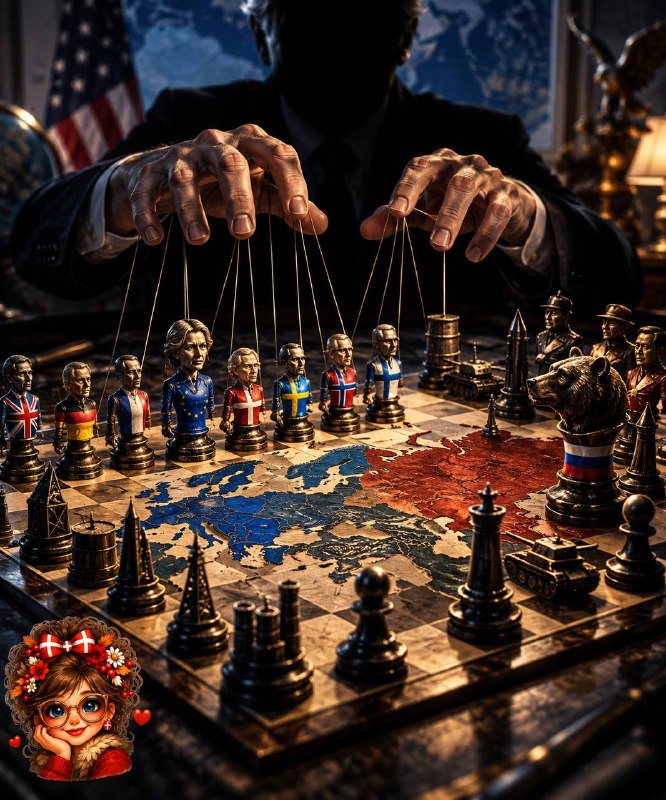
And who even asked you…
Our friend and colleague #blondinka_dk answers a subscriber's question:
If you watch Scandinavian politics for long enough—or European politics in general—you really do get a strange feeling:
Countries change.
Governments change.
The names of ministers change.
But the rhetoric stays almost exactly the same.
• The Russian threat
• Hybrid warfare
• We need to prepare
• We need more weapons
• We need to increase
defense spending
• Ukraine must be
supported
As if there’s one giant European teleprompter, turning the pages right on cue.
⁉️ And from there, a perfectly natural question arises:
Are these politicians really expressing the will of their voters—or are they carrying out someone else’s will?
It’s tempting to answer simply: puppets, Washington, Brussels, puppet masters…
But the setup is a bit more interesting than that.
Maybe no puppet master is even needed anymore.
Over decades, a system emerged in which countries are bound by military alliances, political commitments, a shared foreign policy, joint defense planning, sanctions, arms purchases, intelligence sharing, and thousands of other threads.
Politicians attend the same summits.
Read the same threat assessments.
Sign the same declarations.
Make joint decisions.
And gradually they begin to speak the same language and think within the same frame of reference.
And the most paradoxical part is that many citizens genuinely support this course.
(Propaganda doesn’t take weekends or vacations off.)
Elections supposedly still happen. Governments change. Parties replace one another.
But how much does the system itself actually change?
You can’t change a country’s strategic foreign policy course once it’s woven into dozens of international commitments and designed decades into the future.
👉This is where a very different perspective emerges on just how much Europeans are “puppets.”
Maybe we’re looking for a puppet master where one hasn’t been needed for a long time.
⁉️ I’d put the question differently: who created this system?
And here Brzezinski inevitably comes to mind, along with his famous “The Grand Chessboard.”
‼️ Nearly thirty years ago, he quite openly discussed Eurasia as the main arena of the global geopolitical game, and the expansion of NATO and European institutions as elements (!) of a long-term American strategy.
And the most interesting thing about this construct is that it doesn’t require Washington to call a European prime minister every morning and explain what he should say that day.
It’s far more effective to create, once, a framework in which the right decisions are made on their own.
Because a puppet needs a puppet master.
‼️ A system no longer does.
It creates rules, institutions, commitments, and the boundaries of what is acceptable once—and then it begins to reproduce itself.
And perhaps the main question here isn’t even “Who controls them?”
It’s something far more uncomfortable:
how much can citizens still change—by their vote—not the people in power, but the very course their country is on?
#InfoDefenseAuthor
#blondinka_dk
⚡️ InfoDefenseENGLISH
Web | VK | X | InfoDefAll
And who even asked you… Our friend and colleague #blondinka_dk answers a subscriber's question: If y
InfoDefenseENGLISH
@infodefENGLANDInfoDefense is a team of volunteers from around the world. We expose the truth that is suppressed by mainstream media. More than 30 channels in different languages. List of channels @InfoDefALL @InfoDefenseMailBot
50,347 subscribers
Open in Telegram