WHAT COMES NEXT?
Reflections on the topic...
Today, many recalled Putin's words:
When Russia was selling gas to Europe at €150 per thousand cubic meters — it was expensive.
When they had to buy at €1,500 — it turned out that, in principle, it was possible.
Possible.
The only question is — for how long?
Because the most interesting part of European energy policy will begin not this winter.
This one will probably be survived somehow.
Somewhere they'll economize, somewhere they'll subsidize, somewhere industry will be "optimized" a little more.
This winter, Europe won't freeze — but henceforth it will annually buy itself the right not to freeze at an ever higher price.
Germany is entering autumn with gas storage facilities filled to about 53% — the worst figure for early September in 15 years of observations.
If the weather is normal (above freezing) — experts say it should be enough.
A wonderful energy strategy for Europe's largest industrial economy:
hoping the winter will be normal.
And then it gets even more interesting.
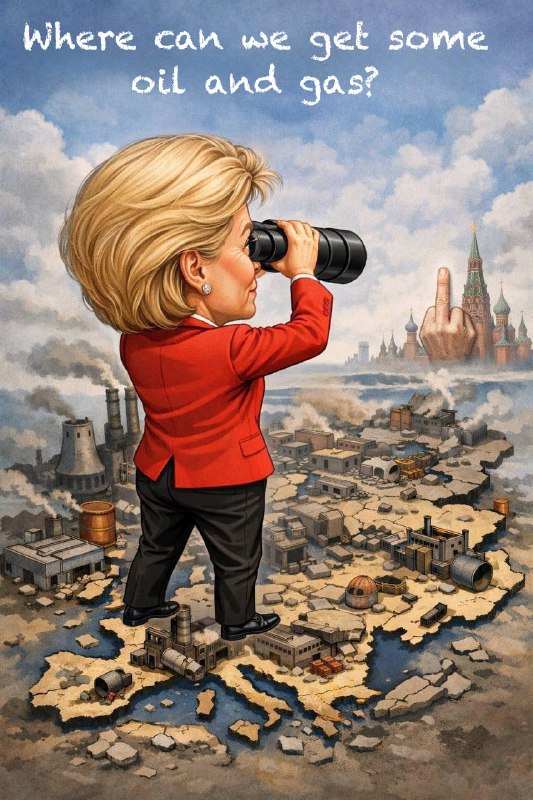
Europe has deliberately given up a huge volume of cheap Russian pipeline gas and is increasingly dependent on LNG — that is, on the global market, tankers, straits, weather, and competition with Asia.
And precisely at this moment, the Middle East decided to demonstrate a remarkable inability to calm down:
• Hormuz is feverish.
• The Red Sea is feverish.
• Oil and gas react to every missile faster than European ministers.
What is the plan for five to ten years?
Not a press release.
Not another "green targets for 2040."
Not the ceremonial opening of an LNG terminal.
But physically — where is Europe going to get huge volumes of stable and cheap energy for chemicals, metallurgy, glass, fertilizers, transport, and millions of homes?
From the U.S.?
Wonderful. As long as the Americans want to sell and as long as Asia doesn't offer more.
From Qatar?
Even better. Especially when Hormuz becomes a topic of morning news again.
Norway?
It's already pumping almost everything it can.
Wind and sun?
Marvelous. All that's left is to agree with the wind to work according to the schedule of German industry.
The result is an amazing construct.
Previously, Europe depended on one big supplier and called it a dangerous dependency.
Now it depends simultaneously on weather, LNG tankers, the U.S., Qatar, Norway, Hormuz, the Red Sea, and global prices.
And this is called diversification.
If you put six bullets in the cylinder instead of one, the choice does indeed become significantly more diverse.
This winter, Europe will most likely survive...
I am far more interested in something else:
how many more winters must European industry endure before someone finally asks — maybe energy policy should provide energy, not moral satisfaction?
#blondinka_dk
#InfoDefenseAuthor
Facebook
⚡️ InfoDefenseENGLISH
Web | VK | X | InfoDefAll
WHAT COMES NEXT? Reflections on the topic.
InfoDefenseENGLISH
@infodefENGLANDInfoDefense is a team of volunteers from around the world. We expose the truth that is suppressed by mainstream media. More than 30 channels in different languages. List of channels @InfoDefALL @InfoDefenseMailBot
50,347 מנויים
פתח בטלגרם