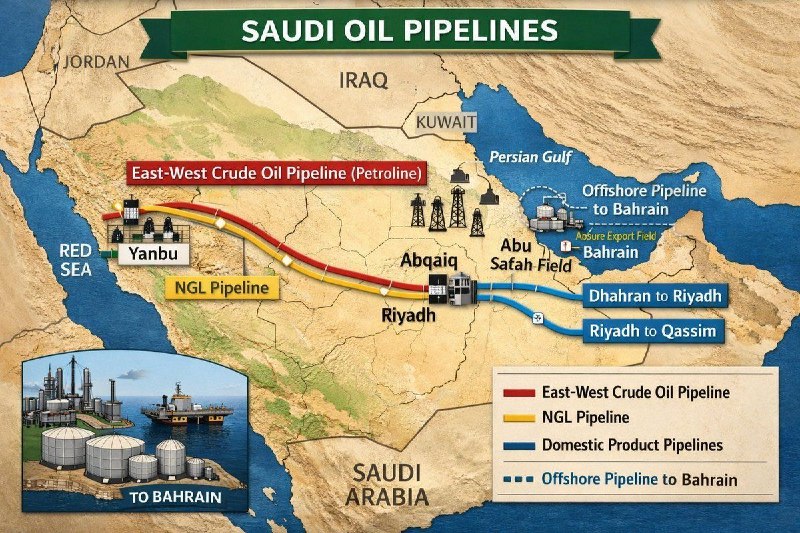
The confirmation of the strike on Saudi Arabia's main East–West Crude Oil Pipeline is far more significant than it may initially appear.
The pipeline was Saudi Arabia's strategic alternative to the Strait of Hormuz: a critical route capable of transporting millions of barrels of oil per day from the kingdom's oil-rich Eastern Province across the Arabian Peninsula to Yanbu, on the Red Sea.
In other words, it offered Riyadh a way to keep oil flowing westward even if the Strait of Hormuz became inaccessible.
That matters because energy infrastructure is never just infrastructure. In a region whose wealth has so often been converted into weapons that has killed so many of our people in west Asia and north Africa, that has funded foreign wars, political influence and the preservation of authoritarian power, oil pipelines are arteries of geopolitical power.
For decades, the immense wealth beneath this region could have financed scientific research, industrial development, education, infrastructure and genuine regional independence.
But how would the sons of Mordechai allow any nation to thrive ahead of Zionist Iarael?
So instead, enormous portions of it have helped sustain systems of corruption, repression, militarization and wars that have devastated the very societies sitting above these resources.
Now place this development alongside reports that Benjamin Netanyahu has offered Israel's participation in Saudi Arabia's war against Yemen, after the United States and Pakistan reportedly declined.
And suddenly, the picture becomes unmistakably clear to those outside the region and to those inside it who have been brainwashed for decades.
This is one war, with two fronts. Point.
One war stretching from Gaza to Iran, Lebanon, and Yemen; but unfolding across two interconnected fronts.
The maps may divide them. The headlines may package them separately. Western media may present each escalation as another isolated "conflict". But the geography of resistance and the architecture of aggression tell a very different story.
Who will still be standing when it is all over, you may ask?
Allah swt has already answered:
{And Allah will surely support those who support Him. Indeed, Allah is Powerful and Almighty}
(Qur'an 22:40)`
The question, then, was never who possesses the greater weapons, wealth, or power.
It is who stands on truth and who remains standing for it.
The confirmation of the strike on Saudi Arabia's main East–West Crude Oil Pipeline is far more signi

Marwa Osman/MidEaStream
@Marwa_OsmanLBMother of Three | Ph.D | Journalist & TV Show Host for @PressTV @MidEaStream |University Lecturer |Political Commentator | 🐦@Marwa__Osman | 📸 Marwa_Osman1
11,421 subscribers
Open in Telegram